How many times have you written an article you genuinely liked, hit publish, checked your stats and saw almost nothing? No traction. No engagement. Sometimes, not even a single comment. We are about to discuss everything about “why your articles are not getting reads?”
If you’ve ever sat there wondering why your articles are not getting reads even though you know the writing is solid, you’re not alone. Many writers are quietly dealing with this, and it’s not because they suddenly forgot how to write.
“The internet is no longer short of good writing. It is short of attention.”
That single sentence explains why good writing alone is no longer enough to get readers today. The online writing space is crowded, competitive, and fast-moving. Millions of articles are published every week, and readers are constantly choosing what to ignore. This means the rules have changed. Quality still matters, but it is no longer the deciding factor.
1. Good Writing Is Everywhere, So It’s Not an Advantage Anymore
One of the biggest mindset shifts writers must make in 2026 is accepting this truth: good writing is expected, it’s like the basics.
For instance, as a reader, before scrolling through these points, you already assumed the blog would be clear, readable, and grammatically sound, and you feel a little bit disappointed in the skill of the writer when there are a lot of errors that you can glaringly identify. Platforms assume the same too. That means quality writing is no longer what sets you apart; it is simply what allows you to participate from the outset.
This is why many writers feel confused. They did “everything right”: a strong introduction, a clean structure, and useful ideas. Yet the article still struggles. The problem is not the writing itself, but the assumption that quality automatically earns visibility.
Think about how you read online. When you search for an answer or scroll through a platform, you don’t stop because something is “well written.” You stop because:
- the headline speaks directly to a problem you have
- the angle feels fresh or specific
- The opening makes you feel understood and just briefly explains that it is exactly what you are looking for.
So, when writers ask why their articles are not getting reads, the answer is often that their work sounds fine but not distinct. In a crowded market, being good is common. Being clear about why this article matters now is what earns attention.
2. If People Can’t Find Your Article, They Can’t Read It
Another hard truth many writers avoid is this: publishing is not promotion.
In earlier years, platforms did more of the heavy lifting. Today, visibility is influenced by early engagement, sharing behaviour, and external signals. If your article is published and then abandoned, it is unlikely to travel far.
This doesn’t mean spamming links everywhere. It means understanding that writing online is no longer just about expression; it is also about intentional distribution.
Writers who consistently get reads usually do a few quiet things differently:
- they share context when posting links, not just the link itself
- they participate in conversations related to their topic before and after publishing
- they repurpose ideas across platforms like LinkedIn, newsletters, or X
- Be very strategic about your distribution after posting
3. Sounding Like Everyone Else Is the Fastest Way to Be Ignored
One uncomfortable reason why your articles are not getting reads is that they sound familiar, it’s really not bad, it’s just that it makes you too familiar, so you don’t stand out anymore.
One thing everyone must understand about the internet is that it is full of well-structured articles that explain ideas clearly but say nothing in a way that feels personal, specific, or lived in. When readers feel like they have read the same article before, even if they haven’t, their attention drifts quickly.
This often happens when writers rely too heavily on:
- generic introductions
- recycled examples
- safe language meant to please everyone
In contrast, articles that perform well usually carry a sense of perspective. They feel like someone who has been there is talking, not summarising. This does not mean oversharing or being dramatic. It means grounding ideas in observation, experience, or clear reasoning.
For example, two articles can explain the same concept. One reads like a guide. The other reads like a conversation that says, “Here’s what I noticed. Here’s what worked. Here’s what didn’t.” Readers remember the second one. See example below:
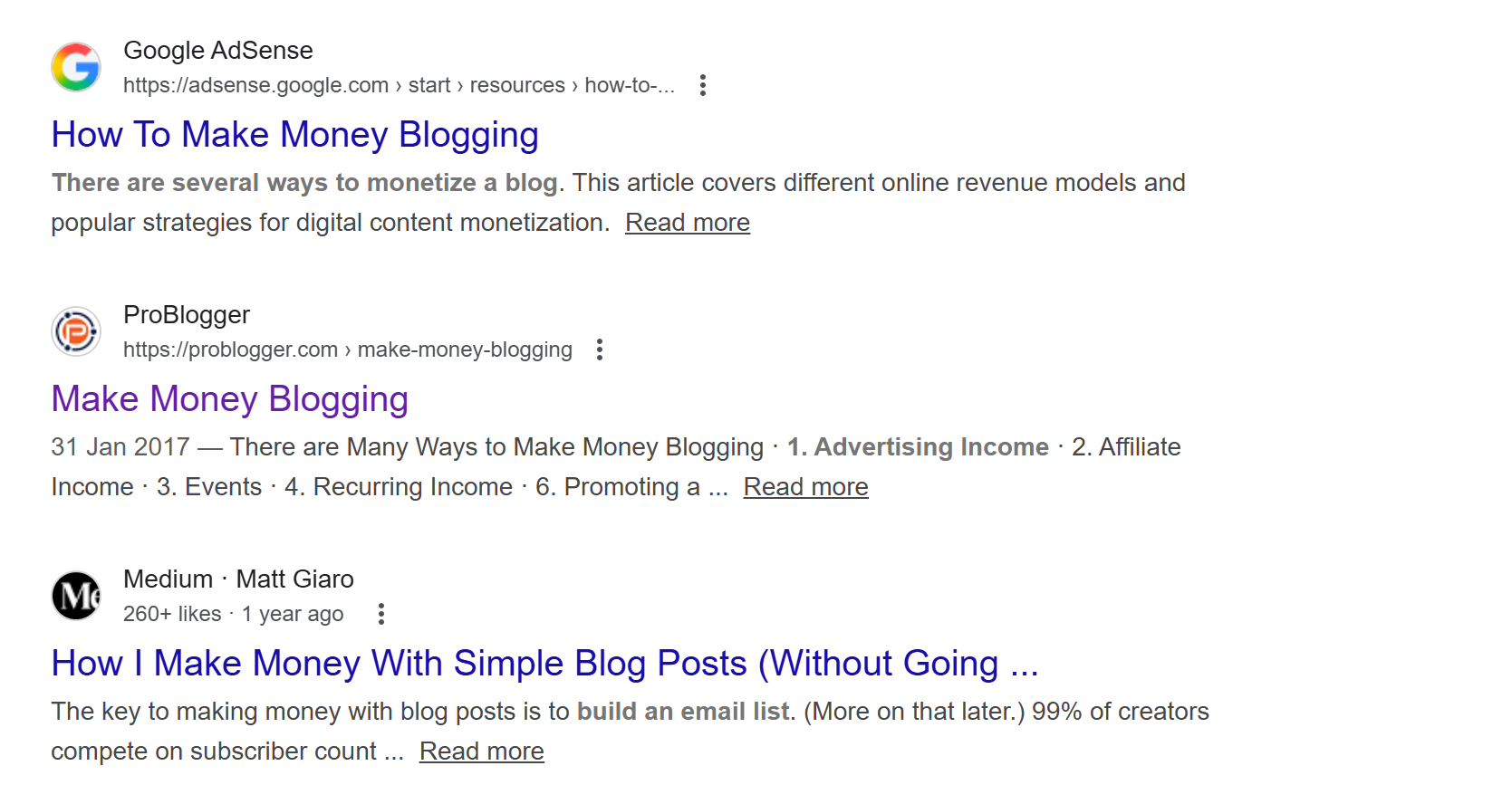
I took a screenshot of my browser when I asked a question on “How to make money with blogging?” Based on the imagery above, if you were to click on anything, which would you quickly go for? I bet that it’s: How I Make Money With Simple Blog Posts (Without Going Viral), right?
So, if you’re asking why your articles are not getting reads, look closely at whether your writing reflects you or just information. Information is everywhere, and a good personal perspective creates a connection with readers and even leads to more purchases of what you are selling.