Category: business ideas Page 2 of 16

Saturated or Unsaturated Markets: Which Offers Better Chances of Wealth?

People love to say, “Don’t enter a saturated market, there’s too much competition.” It sounds smart, but is it really accurate? Because when you look at the world today, the most saturated products we know, water, soap, bread, phone data, and food delivery, are still minting fresh millionaires every single day. What a good way to start the discussion on saturated markets vs. unsaturated markets. You are in for an exciting read, dear reader. 

In fact, the honest debate about saturated markets vs unsaturated markets should not be about which one is “better,” but which one gives YOU the highest chance of making money at the stage of life and business you are in right now.

If 2025 has shown us anything, it’s this: Some entrepreneurs became wealthy very fast by joining industries where thousands already exist, while others quietly built completely new categories and became pioneers. Both sides are winning. They’re just winning for different reasons.

So, let’s break down the truth with research and examples you know.

What Are Saturated vs Unsaturated Markets?

A saturated market is a business area with many sellers, fierce competition, and customers who are already spending money daily. A market like: Fashion accessories on Instagram, food businesses, beauty & skincare brands everywhere, smartphone repairs, a popular business on every street corner you pass through. The beautiful thing about this market is that the money is already flowing.

An unsaturated market has few players, unclear or growing demand, and customers who are still learning what they truly need. Think AI tools for small businesses, robotics in agriculture, drone delivery in hard-to-reach communities, solar payment innovations, opportunity is fresh, and expectations are flexible.      

But here’s the absolute truth about saturated markets vs unsaturated markets: 

The Case for Saturated Markets: Fast Money, If You Can Stand Out

Saturated markets are crowded because demand is predictable. For instance, people already want what you are selling. You don’t need to convince anyone that they need a new dress, better-tasting food, cheaper smartphone accessories, or a more fun café experience. They are already searching for it daily.

Why do saturated markets still produce wealthy entrepreneurs?

  • People are already buying. You show up to sell.
  • Competitor data already exists. You can copy what works and improve on it.
  • Customers already understand the product. No long education phase.
  • You can more easily predict revenue, pricing, and costs.

Research from Global Entrepreneurship Monitor reveals that 70% of profitable startups enter markets where demand is already established, not brand-new ones.

A saturated market can make you wealthy much faster if your offer stands out.

Crowded space doesn’t kill opportunity. Not been able to stand out actually does. Someone else may be cheaper. Another might offer free delivery. Another gives “Buy 1 Get 1 Free.” So you can’t just join the competition; you must change the rules slightly enough to be irresistible.

Examples we all know:                             

Brand. Market Status. Why They  Won 

  • Starbucks. Coffee (super saturated). Brand story and lifestyle experience
  • Tecno & Infinix. Smartphones in Africa. Affordable pricing  and battery life 
  • Canva. Design tools everywhere. Easy to use for beginners

You will notice that Starbucks didn’t invent coffee. Tecno didn’t invent phones. Also, Canva didn’t invent design tools. They all improved something people already loved and made an irresistible offer to meet market demand.

So, if you want cash flow quickly? Saturated markets will give you:

Does Writing Really Pay? 4 Truths I Discovered That Will Change How You Think About Money

Writing paid my bills. Not overnight, not by accident, but by intention and systems. If you’ve ever wondered, ”Does writing really pay?”, the short answer is: yes, but not in the way many expect. 

Writing is more than putting words together. It’s a way of thinking clearly, solving problems, influencing decisions, and packaging ideas into products that people are willing to pay for. 

In this blog post, I will be sharing my own truths on this question, and if you can truly read it through, you can actually make very good money off your writing skills. 

Below are four truths I learned that changed my income and how I treat writing as work.

Truth 1: Writing Turns Ideas Into Income by Forcing Clarity

Before writing anything, an idea feels perfect in your head. But the moment you start typing, researching, you begin to see the gaps.

  • Who is this for?
  • What problem does it solve?
  • Is it useful?
  • Why should anyone care?

Writing forces you to answer these questions, test an idea end-to-end, from headline to solution, and that process exposes what’s sellable, be it a new product, course, or service idea.

7 Digital Mobile Business Ideas to Cash Out From in 2026

If 2025 proved anything, it’s that you don’t need an office to run a global business. From Africa to the UK to the U.S., and literally anywhere in the world, young entrepreneurs are using their phones to run profitable digital mobile businesses, from content creation to online tutoring and dropshipping.

According to Statista, the number of mobile internet users worldwide has now exceeded 5.5 billion, and over 70% of e-commerce transactions in developing regions happen on mobile devices. That means the world of business is literally in your pocket,  and 2026 is shaping up to be the year when flexibility meets profitability.

Whether you’re a student, a stay-at-home parent, or a full-time creative, these digital mobile businesses can help you earn, grow, and expand, all from your phone or laptop.

The Simple Maths of Financial Leveraging: Ratios, Measures, and the Analysis.


Part 2: Ratios, Measures, and the Math Behind Financial Leverage

Understanding the Numbers Behind Financial Leverage

In Part 1, we explored what financial leverage means and why it’s essential for business growth. In this part, we’ll go deeper into the numbers.

Financial leverage refers to the extent to which a company uses debt to fund its operations and investments. To manage debt wisely, business owners and investors should understand the key ratios that measure it.

These financial leverage ratios act as your dashboard indicators. They show how much risk your company is carrying, how efficiently it’s using borrowed money, and how sustainable your growth plan is.

Let’s break them down.

1. Debt-to-Equity (D/E) Ratio

This is the most popular measure of leverage. It compares the amount a company owes to the amount it owns.

D/E = Total debt/Total Equity

  • Total Debt includes all short-term and long-term borrowings.
  • Total Equity refers to shareholders’ funds, including invested capital and retained earnings.

A higher D/E ratio indicates that the company relies more on borrowed funds. A lower ratio shows the company depends more on its own funds.

For example, if your business has $5 million in debt and $10 million in equity, your D/E ratio is 0.5. This means that for every $1 of equity, you have $0.50 in debt — a healthy balance for most industries.

However, if your debt jumps to $15 million while equity remains $10 million, your D/E ratio becomes 1.5. Now, for every $1 of equity, you owe $1.50, a sign of higher risk.

Tip: Manufacturing and capital-intensive firms often have higher D/E ratios than service-based companies. Always compare within your industry.

Why Now is the Most Profitable Time To be a Writer (Even New Writers)

If you want to become a writer, now is the best time to start. Unlike in 1998 when newspapers hired many writers, 2010 when blogging was popular, or even 2016 when poetry was the order of the day on Instagram, 2025 offers the best opportunities. This is a profitable time to be a writer and earn money.

Why is now the best time?

Writing has changed. It is no longer just a skill; it is a valuable tool. Today, writing can be a product, a service, a brand, a business, or a way to grow an audience without showing your face. The good news is that getting started is easier than ever.

All you need is to understand what type of writer you want to be and how your work can make money.

Why is Now the Most Profitable Time To Be a Writer? And how can you take advantage of these opportunities?. All will be adequately discussed in this blog post. 

1. Writing Has More Income Streams Than Ever Before

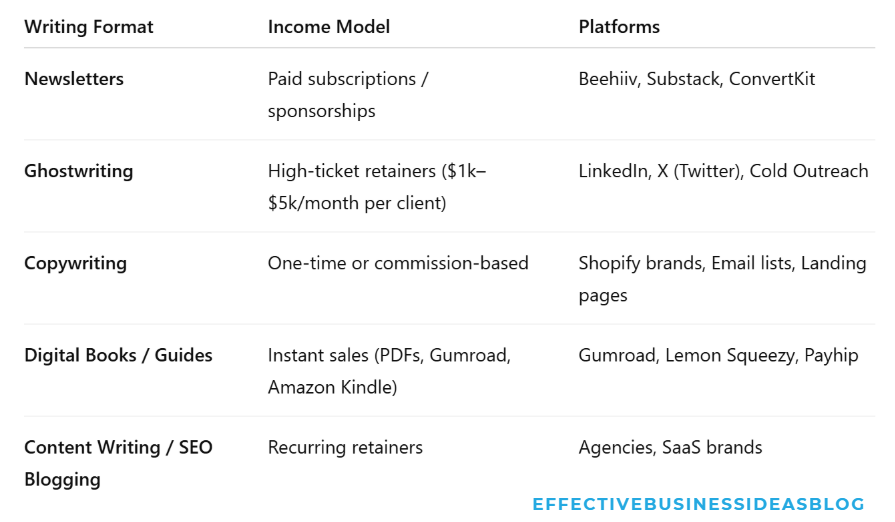
Before now, a writer had two options: publish a book or get hired by a newspaper. Today, anybody can make money even without being famous, simply by placing their writing strategically. 

See the various ways writers are earning in 2025:

According to ConvertKit’s 2024 Creator Report, writers earning over $100k/year increased by 43% in just one year. And guess what? Most of them don’t even have “bestselling author” attached to their bio.

The gap is no longer between published and unpublished writers, it’s between visible and invisible writers. For instance, there is a YouTube channel that makes videos about Software engineering and interviews about tech and startups. It has 146k subscribers on YouTube, and its Substack newsletter, “The Pragmatic Engineer,” is crossing $1M per year as a one-person media brand. 

This just attests to the point that nobody needs permission anymore. All you need is distribution, and for the first time in history, platforms are rewarding writing by including algorithmic reach and direct monetisation.

2. AI Isn’t Replacing Writers (It’s Making the Smart Ones Richer)

Let’s settle this: Artificial intelligence tools aren’t here to replace writers, they’re here to replace slow writers.

People who treat AI like a cheat code instead of a competitor are producing five times more work in half the time, which means they earn faster, pitch faster, publish more, and get seen more. Before now, writing one blog post could take a whole afternoon. Today? You can outline in Notion AI, draft in ChatGPT, refine with GrammarlyGO, and schedule with Typefully, all in under an hour.

That doesn’t make writing less valuable, it makes your time more useful. Even bestselling author Morgan Housel put it best in an interview: “AI won’t kill original thinking. It’ll kill lazy phrasing.”

So instead of asking, “Will AI replace writers?”
The real question is: Will you be the writer who uses AI to write 10x more… or the one who gets left behind because you’re still typing like it’s 2012?

If you are ready to build a profitable business or career as a writer, using AI tools and resources, now is the perfect time to multiply your earnings. 

Six Steps to Start a Smart Subscription Business without Coding

Subscription-based businesses can be highly lucrative when executed well. They provide a predictable income, which, when nurtured properly, can produce a consistent flow of revenue for your business, whether small in scale or large. According to a report from Grand View Research, the global subscription economy is estimated to reach as much as 1.5 trillion by the year 2033.

Image Screenshot Link

This is not just a simple proposal, considering the analytical report from Quick Market Pitch, which reveals that the subscription market grew by over 15% in 2024. Over the last ten years, organisations using subscription models have increased by 435%. The issue, however, is that when many people think of Subscription businesses, they start thinking they need a software engineer to write code and a line of software code in order to get to that point where they can begin running one effectively. However, in today’s effective business blog post, I will walk you through six steps that you can take to easily start a subscription business without breaking the bank. 

STEP 1: PICK YOUR AREA OF FOCUS

The first step is to start with your strength, a blend of something you are very skilled at and what is potentially affordable. Don’t pick something that requires a lot of complexity to offer. Complexity is often the undoing of many ideas – it’s too complex to get started with.

Decide what you’ll offer on a subscription basis. This can include digital products like e-books, courses, stock photos, templates, and newsletters. You might also provide services such as consulting hours, coaching sessions, or fitness programs.

Physical products like subscription boxes with books, snacks, or skincare items are also an option. Additionally, you could offer content or community access, such as private communities, exclusive videos, or premium podcasts. The key is to think about providing recurring value, something people need or enjoy regularly.

The 3-Part Launch Formula I Wish I Knew Earlier: How to Finally Launch in 7 Days

If you’ve been wondering how to launch an idea in 7 days, you’re not alone. Research shows that over 70% of people have an idea, a blog, podcast, small business, or Instagram page, that they never launch.

Why? Because like us, they overthink. They wait for the “perfect time,” the perfect logo, or enough money to make it flawless. And that perfect moment never comes.

I’ve been there too. Stuck planning, tweaking, waiting for everything to feel ready. Until I discovered a simple, real-world approach to launch any idea in just one week.

In this post, I’ll share the 3‑part formula that can help you go from “just an idea” to launched in 7 days. Even if you’re on a budget, unsure, or starting completely from scratch.

Part 1: CLARIFY—Know Exactly What You’re Launching (Day 1–2)

“If you are confuse, you lose.” — Donald Miller, Building a StoryBrand

Before you build it, you must name it. Most people stall because they have too many ideas and no clear direction. Launching isn’t about doing everything; it’s about starting something simple and focused.

Writer, freewriting ideas

Write the Idea As It Is

Pick up a notebook, open a Google Doc, or grab your journal and describe your idea in plain words. Don’t worry about perfection. Just get the idea out of your head.

Sharpen the Idea

Ask yourself:  

  • What am I launching? (Is it a service? a digital product? a YouTube channel?)
  • Who is it for?. 
  • What problem does it solve right now?

Define Your Offer in One Sentence

You can use this structure:  “I help [who?] solve [what problem?] through [method/solution].”

For example: 

  • I help young African creatives grow on Instagram through storytelling and niche content.
  • I teach beginner freelancers how to land international clients through cold email outreach.

Define the Purpose of Your Launch

Now, pick one major goal for this launch; maybe it’s to:   

  • Build an audience
  • Make money 
  • Test your idea 
  • Share your journey

Free resources: Use Copy.ai or any free headline generator to help create your one-liner. And you are one step closer to discovering how to launch an idea in 7 days.

35 Profitable Small Business Ideas to Start in 2025

If you’re planning to start a business in 2025 but feel overwhelmed by options, you’re not alone. Choosing the right business idea means matching your skills, interests, and resources with real market needs. To help you get started, here are 35 profitable business ideas you can launch in 2025—many with low startup costs and room to scale.

35 Profitable Small Business Ideas

1. Freelance Accounting Services

Many individuals and businesses require assistance with managing their finances, particularly during tax season or when launching a new venture. If you’re already a certified accountant, you can operate independently and serve clients on your terms.

Not certified yet? You can still get started by taking relevant courses or joining tax preparation programs that offer training. Once qualified, you can choose your niche—simple bookkeeping, financial reporting, or even tax accounting, which is in constant demand.

2. Business Consultancy

Consulting offers flexible opportunities to assist businesses at various stages—whether helping startups build solid foundations or guiding established companies through change. You can specialise in business planning, market research, operations, or executive strategy. With experience, you can scale into high-level corporate advisory roles. Time management tools are essential, especially for billing accurately.

3. Social Media Management

Many businesses need help growing their online presence. Suppose you’re creative with content and know how to engage an audience. In that case, you can offer social media services, like content planning, community engagement, and performance tracking—an excellent fit for someone already active on platforms like Instagram, TikTok, or X.

5 “Underrated” Skills That Can Actually Make You a Millionaire (No Joke)

When we think of skills that lead to wealth, we usually picture flashy ones, such as coding, marketing, and sales. But what if I told you that these underrated skills can actually bring you wealth in terms of money, time, and peace?

This post is for you if you’ve ever wondered:
“What should I actually focus on next?”

These five “underrated” might just be the key to building the life (and bank account) you want.

1. The Skill of Decision-Making

Millionaires have underrated skills like deciding, commiting and adjusting quickly. (Quotes )

Can you forget these in-demand skills for a second, skills like Coding, Writing, Digital marketing, Cybersecurity, and many more, your mind is telling you. (Funny, right?). The real skill you need for your future is this:

  • figuring out what exactly you want,
  • turning that into a goal,
  • creating a plan,
  • and following through, without panicking midway if it was the “right” goal.

That’s called decision-making, and it’s what separates people who build a life they love from those who keep hopping from thing to thing.

In an insightful book Thinking, Fast and Slow, psychologist Daniel Kahneman reveals how our minds often rely on mental shortcuts, illustrated by concepts like the Allais Paradox, which can lead us to make regrettable financial choices. Yet, the traits of successful millionaires go beyond mere talent; they hinge on the essential skills of decision-making, commitment, and flexibility. In fact, some of these people even gather the team, experience failure and start all over again. 

By improving your decision-making skills, you will find it easier to weather the storms that come up in any field, whether it’s finance, art, freelancing, technology, or others.

2. Learning How to Learn

Dropshipping in 2025: Is It Still Worth It?

Back in 2021, dropshipping really caught the eye of many new entrepreneurs. It seemed like an exciting and accessible way to enter the world of e-commerce. Its low costs, minimal need for inventory, and the chance to reach customers all over the globe made it especially appealing for those eager to get started online.

Moving into the year 2025, and the conversation has shifted. People are now asking: Is dropshipping still a good idea? Do the opportunities still exist, or has everything changed so much that it’s no longer worth considering?

In this article, we’ll take a friendly, honest look at how things have evolved. We’ll explore which tools and strategies are still useful, and whether dropshipping remains a viable way to earn money today.

Whether you’re just starting out or thinking about giving your existing dropshipping business a second look, understanding these updates can help you move forward with confidence and enthusiasm.

7 Ways to Earn More in 2025 Without Working 7 Hours a Day

Page 2 of 16

Theme by Anders Norén & Customized by Karol K