Author: iamTomithebrand Page 2 of 18

The New Way Writers Are Growing Readership in 2026

If you’ve been writing consistently but still wonder how writers grow readership in 2026, you’re asking the right question.

Just a few years ago, many bloggers counted on SEO + volume = traffic. Today, that equation is shifting. Search engines, social platforms, newsletters, and even human behaviour around content consumption have all changed. The old model, write more, publish often, wait for Google clicks, just doesn’t work like it used to.

According to global blogging data like Webtribunal, there were over 600 million active blogs worldwide in recent years, with millions of new posts published daily, and billions of readers engaged monthly. But that sheer volume means competition is fierce and visibility is no longer automatic.

The truth is this: quality content is still necessary, but it no longer drives growth by itself, as I discussed in a previous article Why Good Writing Alone Is Not Enough to Get Readers in 2026. Writers today grow their readership through strategy, rhythm, platforms that meet readers where they are, and distribution that connects rather than just publishes.

Here’s how writers are actually growing today, and how you can too.

1. Writers Are No Longer Betting on One Platform

One of the biggest changes in how writers grow readership in 2026 is that successful writers are no longer loyal to a single platform.

A few years ago, writers were told to “pick one platform and go all in.” Medium, for example, became a major home for many writers because of its built-in audience. That advice is now outdated. Medium still works, but only as part of a larger system.

Although publishing on your own blog still matters, it’s your long-term SEO asset and brand hub. People still search for content, and having a well-organised blog helps you appear in search results over time. But reaching new people often requires expanded distribution.

If you look closely at how top writers operate today, you’ll notice a pattern:

  • WordPress or Ghost blogs as an owned SEO base
  • Medium publications to tap existing audiences
  • Substack or Beehiiv newsletters to build direct followers
  • Social channels (like LinkedIn, X, Instagram Reels, TikTok) to signal value and drive traffic back

Several writers have openly shared that relying on one platform is risky because algorithms change, payouts fluctuate, and visibility can disappear overnight. This is why many writers now treat platforms like Medium as traffic sources, not final destinations.

Platforms like Substack have grown rapidly because they combine writing and newsletters into one, allowing creators to build a direct relationship with readers rather than relying on search alone. Substack’s built-in discovery features and email subscription focus help writers attract and retain audiences more predictably than traditional blogs alone.

Even brands are using newsletter platforms for storytelling and engagement outside the noise of short-form social content, for example, Rare Beauty has used Substack to create engaged conversations and valuable visits that don’t depend on Instagram algorithms.

The lesson? Writers who understand how readers behave across platforms grow readership faster than those who rely on any single channel.

2. Repurposing Across Formats: 10x Value from One Idea

One clear pattern among writers who know how to grow readership in 2026 is this: they don’t treat writing in isolation. They treat ideas as multi-format assets.

A single topic can become:

  • A long-form blog post
  • A newsletter thread
  • Short-form video (YouTube Shorts, TikTok, Instagram Reels)
  • LinkedIn or X posts
  • Podcast segments
  • Infographics and carousel posts

Why Good Writing Alone Is Not Enough to Get Readers in 2026

How many times have you written an article you genuinely liked, hit publish, checked your stats and saw almost nothing? No traction. No engagement. Sometimes, not even a single comment. We are about to discuss everything about “why your articles are not getting reads?” 

If you’ve ever sat there wondering why your articles are not getting reads even though you know the writing is solid, you’re not alone. Many writers are quietly dealing with this, and it’s not because they suddenly forgot how to write.

“The internet is no longer short of good writing. It is short of attention.”

That single sentence explains why good writing alone is no longer enough to get readers today. The online writing space is crowded, competitive, and fast-moving. Millions of articles are published every week, and readers are constantly choosing what to ignore. This means the rules have changed. Quality still matters, but it is no longer the deciding factor.

1. Good Writing Is Everywhere, So It’s Not an Advantage Anymore

One of the biggest mindset shifts writers must make in 2026 is accepting this truth: good writing is expected, it’s like the basics. 

For instance, as a reader, before scrolling through these points, you already assumed the blog would be clear, readable, and grammatically sound, and you feel a little bit disappointed in the skill of the writer when there are a lot of errors that you can glaringly identify. Platforms assume the same too. That means quality writing is no longer what sets you apart; it is simply what allows you to participate from the outset.

This is why many writers feel confused. They did “everything right”: a strong introduction, a clean structure, and useful ideas. Yet the article still struggles. The problem is not the writing itself, but the assumption that quality automatically earns visibility.

Think about how you read online. When you search for an answer or scroll through a platform, you don’t stop because something is “well written.” You stop because:

  • the headline speaks directly to a problem you have
  • the angle feels fresh or specific
  • The opening makes you feel understood and just briefly explains that it is exactly what you are looking for.

So, when writers ask why their articles are not getting reads, the answer is often that their work sounds fine but not distinct. In a crowded market, being good is common. Being clear about why this article matters now is what earns attention.

2. If People Can’t Find Your Article, They Can’t Read It

Another hard truth many writers avoid is this: publishing is not promotion.

In earlier years, platforms did more of the heavy lifting. Today, visibility is influenced by early engagement, sharing behaviour, and external signals. If your article is published and then abandoned, it is unlikely to travel far.

This doesn’t mean spamming links everywhere. It means understanding that writing online is no longer just about expression; it is also about intentional distribution.

Writers who consistently get reads usually do a few quiet things differently:

  • they share context when posting links, not just the link itself
  • they participate in conversations related to their topic before and after publishing
  • they repurpose ideas across platforms like LinkedIn, newsletters, or X
  • Be very strategic about your distribution after posting

3. Sounding Like Everyone Else Is the Fastest Way to Be Ignored

One uncomfortable reason why your articles are not getting reads is that they sound familiar, it’s really not bad, it’s just that it makes you too familiar, so you don’t stand out anymore.

One thing everyone must understand about the internet is that it is full of well-structured articles that explain ideas clearly but say nothing in a way that feels personal, specific, or lived in. When readers feel like they have read the same article before, even if they haven’t, their attention drifts quickly.

This often happens when writers rely too heavily on:

  • generic introductions
  • recycled examples
  • safe language meant to please everyone

In contrast, articles that perform well usually carry a sense of perspective. They feel like someone who has been there is talking, not summarising. This does not mean oversharing or being dramatic. It means grounding ideas in observation, experience, or clear reasoning.

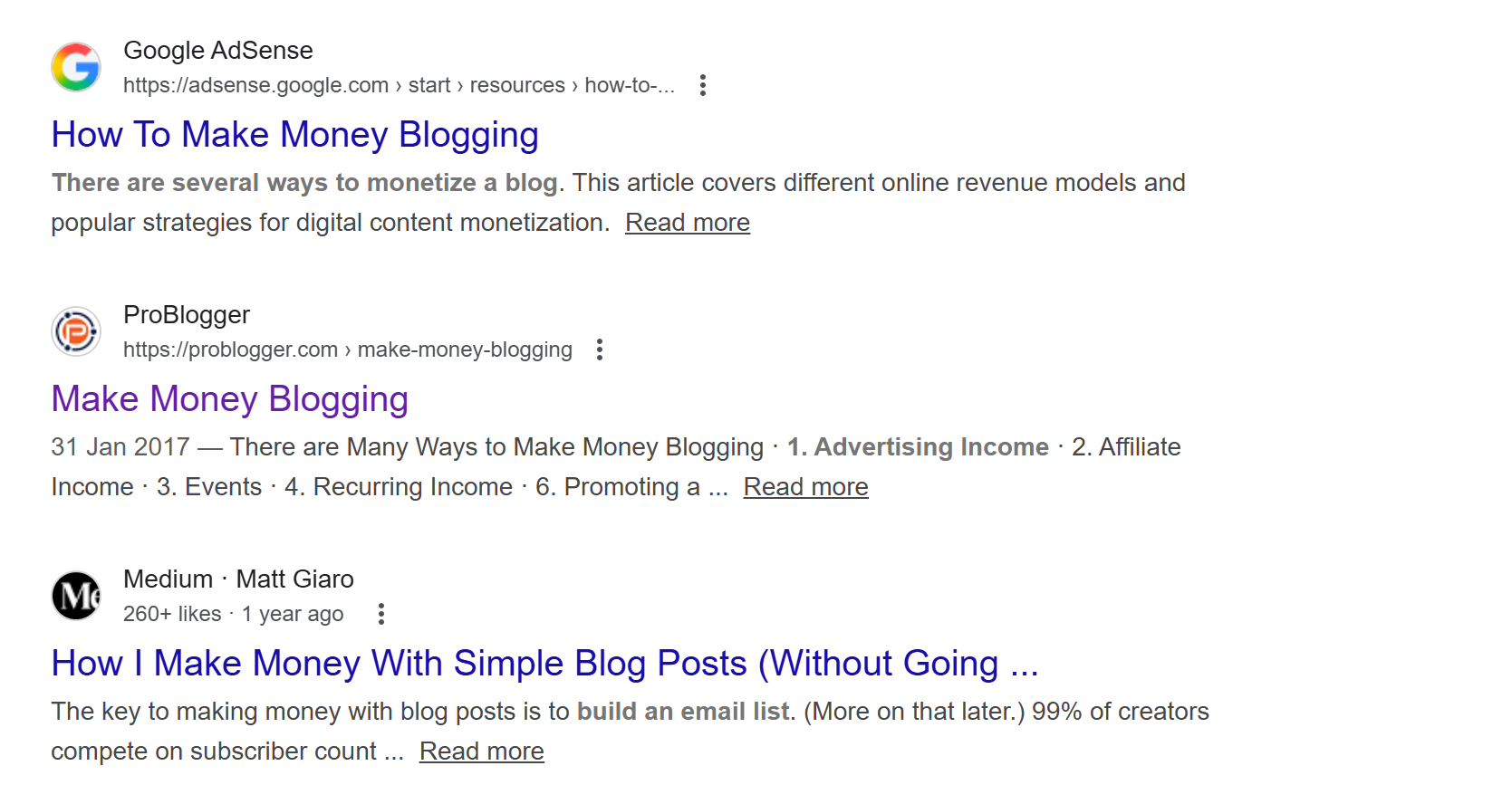
For example, two articles can explain the same concept. One reads like a guide. The other reads like a conversation that says, “Here’s what I noticed. Here’s what worked. Here’s what didn’t.” Readers remember the second one. See example below: 

I took a screenshot of my browser when I asked a question on “How to make money with blogging?” Based on the imagery above, if you were to click on anything, which would you quickly go for? I bet that it’s: How I Make Money With Simple Blog Posts (Without Going Viral), right? 

So, if you’re asking why your articles are not getting reads, look closely at whether your writing reflects you or just information. Information is everywhere, and a good personal perspective creates a connection with readers and even leads to more purchases of what you are selling.

How to Be a Better Writer and Earn More in 2026 (Without Burning Out)

how to earn as a writer in 2026

If you’ve been writing consistently but your income still feels stuck, you’re not alone. All you need is this one blog to learn how to earn more as a writer in 2026.

Many writers are producing more content than ever, blog posts, newsletters, threads, essays, yet earning less than writers did a few years ago. The reason isn’t a lack of talent. It’s that the rules of writing for money have changed.

You too can say that Platforms are now very much smarter. Editors are pickier. AI has flooded the internet with average content. What gets paid for now is not just good writing, but strategic writing, writing that understands platforms, niches, and how attention turns into revenue.

What I propose for you to be able to earn more as a writer in 2026 is not to write harder, but write differently.

This guide breaks down everything and what experienced writers are quietly doing to improve their craft, position themselves better, and increase their income, without burning out or chasing every new platform.

1. Write Where Money Already Moves

One of the biggest mistakes writers make is focusing only on writing better without paying attention to where they are writing. In 2026, earning more as a writer starts with understanding that not all platforms are built to pay writers well, no matter how good the work is.

High-earning writers intentionally publish in spaces where money is already circulating. These platforms attract high readership, decision-makers, founders, professionals, and businesses. Because when the audience has buying power, the writing naturally becomes more valuable. This is why publications focused on marketing, technology, product, business strategy, and professional growth consistently pay better than general lifestyle blogs.

Platforms like Better Marketing, UX Collective, and The Startup on Medium work because they attract readers who are actively trying to improve outcomes in their work or businesses. On the independent side, platforms such as Smashing Magazine or Contently pay professional rates because their content directly supports industries that generate revenue.

This is also why owning your own blog or newsletter matters. When you write consistently on a personal blog or Substack, you create a space where your ideas compound over time. Search traffic, referrals, and shares can bring in readers months or even years after publication. Writers who learn how to earn more in 2026 and are doing the work are not chasing attention everywhere; they are placing their work where value already exists. I would suggest you go over the articles below once you are done reading this: 

6 Writing Platforms That Still Pay $100+ Per Article in 2026 (No Client Hunting)

Most people assume online writing only pays in exposure, likes, or small change. For years, many writers publish article after article for free, hoping that someday it will lead to money, clients, or recognition. The truth is simpler and more uncomfortable: many writers stay unpaid because they don’t know where to publish. But not anymore. With this guide, you will learn the writing platforms that pay in 2026.

There are platforms that already value good writing. Platforms where you don’t need to chase clients, negotiate endlessly, or prove yourself on social media first. You show up, submit strong work, and get paid per article.

So, if you’re looking for writing platforms that pay per article in 2026, realistically, not magically, this list will point you in the right direction. These are places where one well-crafted piece can earn $100 or more, without needing years of experience or a massive audience.

1. Better Marketing 

Better Marketing is one of the strongest examples of how writing tied to business value is well paid in 2026. The platform focuses on marketing strategy, branding, audience growth, content creation, and the creator economy. This is not a place for vague motivation or surface-level tips. Articles here break down how brands grow, why campaigns succeed or fail, and how creators and businesses can position themselves better in competitive markets.

The reason Better Marketing pays writers well is simple: marketing content attracts decision makers. Founders, marketers, consultants, and business owners actively read this publication, and that audience directly converts into paid Medium subscriptions, tools, and services. Because of that, writers who publish strong, practical pieces often earn well over $100 per article through Medium Partner earnings, with some pieces generating much more over time.

Acquire These Top 15 In-Demand Skills and Increase Your Income in 2026

Happy New Year! If you’re reading this in early 2026, chances are you’ve already written down your goals, but somewhere deep in your mind is running questions like: How do I Tick out All My Goals? Will I earn more, or stay stuck doing the same thing? What are the in-demand skills in 2026?

Every year, people set resolutions. But 2026 feels different. The world is moving faster. Jobs are changing more quickly. Technology is reshaping entire industries in real time. Data from the World Economic Forum’s Future of Jobs Report suggests that nearly 50% of all employees will need reskilling due to automation and digital transformation. In simple terms, the skills that paid your bills two years ago may not be the ones that pay in 2026.

So instead of guessing, waiting, or copying generic advice, let’s talk honestly about in-demand skills in 2026 that can actually increase your income, improve your employability, and prepare you for the future of work.

The skills in this guide are not trends. They are skills people are currently being paid for across the US, UK, Europe, Africa, Asia, and almost everywhere in the world. Although I did not rank them from top to bottom, because each one is valuable depending on where you are and what problems you want to solve.

1. AI Prompt Engineering and AI Workflow Strategy

A Lady Looking into her laptop while doing an AI prompting role... one of the top in-demand skills in 2026

Imagery from Canva Pro!

One of the fastest-rising in-demand skills in 2026 is not just “using AI,” but knowing how to use it well. Even Coursera’s Global Skills Report found that the demand for AI-related skills grew by over 800% in 2025 alone, making it one of the fastest-growing skill categories worldwide. The conversation has shifted. Companies are no longer asking, “What is AI?” They are asking, “Who can help us use AI profitably?”

What it is

AI prompt engineering and workflow strategy involve effectively communicating with AI tools and integrating them into real business processes. This goes far beyond typing random prompts. It’s about designing systems that save time, reduce costs, and improve output.

Over the past two years, tools like ChatGPT, Claude, Notion AI, Midjourney, and Copilot have exploded in popularity. But here’s the gap most companies are facing: many teams have access to these tools, yet very few know how to use them strategically.

What 2025 Quietly Proved About the Attention Economy, And Why It Matters for 2026

If Day 1 reminded us that stability is no longer a place but a skill, then Day 2 pushes us to face something even more uncomfortable: in 2025, attention became the most valuable currency in the world. The attention economy in 2025 quietly revealed what truly worked, what failed, and why some people moved ahead while others struggled, despite working just as hard.

What shaped growth, visibility, income, and opportunity in 2025 was who understood attention and who didn’t.

This is Day 2 of our 12 Days of Christmas series, where we slow down to examine what really happened this year across business, tech, media, creators, and culture so we can enter 2026 with clarity, not confusion. 

If you missed Day 1, we explored how stability completely changed form in 2025. You can catch up via the link before continuing, because today’s lesson builds directly on it.

1. In 2025, Attention Became More Valuable Than the Product Itself

One of the biggest lessons from the attention economy in 2025 is that attention stopped being a by-product of success and became its source.

Across the year, reports showed that creators and digital platforms were pulling advertising revenue that rivalled, and in some cases surpassed, traditional media companies. 

Brands began chasing creators. Investors began following audiences, not just ideas. Platforms began prioritising time spent, not just clicks.

YouTube is a good example of this shift. Under CEO Neal Mohan’s leadership, the platform didn’t just chase virality. With over 2 billion logged-in monthly users globally, for instance, YouTube was able to double down on tools that help creators keep attention longer. Like: 

  • Shorts helped creators get discovered.
  • Long-form content got more memberships.
  • And community tools helped people stay relevant and monetised. 

That balance is why it remained one of the strongest monetisation platforms throughout 2025.

In 2025, people didn’t always win because they were objectively better. They won because they consistently held attention. For instance, the Stanley Cup suddenly became a hot product this year because TikTok made it controversial. 

What 2025 Quietly Taught Us About Stability (With Real Examples You Can’t Ignore)

If there is one lesson from 2025 that almost everyone experienced, whether they could name it or not, it is this: “Stability doesn’t mean safety anymore.” Jobs that once felt safe suddenly didn’t. Businesses that looked successful on the outside felt tense behind the scenes. Even people doing “everything right” quietly felt unsure.

This is Day 1 of our 12 Days of Christmas series, where we are not chasing noise or surface-level lessons. We are taking a step back to reflect on the lessons from 2025, whether you noticed them or not.

In this Christmas series, we will also examine mistakes made across various fields, trends that emerged, and insights shared by experts, investors, and startup owners throughout the year. We aim to gain clarity rather than anxiety, and to find ways to improve our work as we prepare for 2026.

And the first big lesson from 2025? Stability no longer means what it once did.

1. In 2025, “Stable Jobs” Didn’t Feel Stable Anymore

A year ago, many people still equated stability with tenure at a reputable company or a predictable role. But 2025 showed us something surprising:

Even when companies appeared profitable, they still reduced staff, not because they were failing, but because they were reorganising how they work.

By many accounts, tech layoffs were a defining feature of the year. Data shows that in 2025 alone, over 61,000 tech workers were laid off across more than 130 companies as firms restructured roles and refocused on automation and AI integration. 

Companies that once felt like “safe places to be” were cutting jobs in strategic waves. Microsoft, for example, eliminated over 6,000 positions, its largest cut in more than two years, even as it posted strong profits. Also, AP News reported that Amazon’s cloud division also trimmed hundreds of roles as part of broader restructuring, even as AWS revenue continued to climb. 

So stability didn’t vanish; it morphed. It became less about guarantees and more about how quickly you could respond to change.

What 2025 taught us is that being safe no longer comes from the name on the building you work in, but from what you can do. Meaning that, a job title is not a safety net, but Skills, adaptability, and relevance are.

2. The creator economy looked big… but felt shaky

The Good and Bad Side of Loans for Small Business Owners (And How to Know If You’re Ready)

Should you take a loan as a small business owner? We’ve seen businesses take a loan and turn it into their breakthrough moment, the money that changed everything, opened doors, and scaled them faster than they ever imagined. But we’ve also seen loans destroy businesses, drain entrepreneurs emotionally, and wipe out years of hard work because the debt became bigger than the dream. So, what’s it about small business loans? 

We need to understand that money is powerful. And a loan can be a ladder or a trap. And in today’s economy, where entrepreneurs are facing rising costs, unpredictable demand, and tight cashflow cycles, the topic of small business loans is more relevant than ever.

This blog breaks it all down, the good, the bad, the dangerous, the smart, with real examples, expert advice, and mistakes founders often make when borrowing money.

What Exactly Is a Loan? 

According to the Corporate Finance Institute (CFI), a loan is a form of debt in which one party lends money to another with the expectation that it will be repaid, usually with interest, over a defined period.

In simple terms, a loan is money you borrow today to use for growth, stability, or opportunity, and return later under agreed conditions. It is one of the oldest financial tools used to power businesses, from small shops to global corporations like Walmart, Tesla, and Starbucks.

The Good Side of Loans for Small Business Owners

Page 2 of 18

Theme by Anders Norén & Customized by Karol K